Central Iowa Water Works (CIWW) imposed a lawn-watering ban on Monday. This is the second year in a row the water utility has banned watering by its 600,000 customers in the greater Des Moines area and beyond.
“The lawn watering ban is not due to a lack of water in our rivers or reservoirs,” according to CIWW. “Instead, it is necessary because ongoing source water quality challenges are limiting how much water can be treated and delivered while continuing to meet all Safe Drinking Water Act requirements.”
Like last year, the prohibition on watering is the result of elevated nitrate levels in the water sources CIWW relies on: the Des Moines River, the Raccoon River and CIWW’s infiltration gallery (“a perforated pipeline under Water Works Park used to collect and naturally filter water from the Raccoon River,” the utility explains). Federal safety standards limit the amount of nitrates in water for human consumption to 10 mg per liter.
“As of June 8, 2026, the Raccoon River has measured nitrate concentrations above 10 mg/L for 136 days, the Des Moines River has registered 117 days over 10mg/L, and the infiltration gallery has registered more than 10 mg/L for 86 days,” CIWW said on Tuesday. “As a result, the Nitrate Removal Facility has been operating for approximately 95% of the year.”
Normally, there is no need for the nitrate removal facility during winter months, but this year it was necessary to activate it on Jan. 6. It was the first time since 2015, and only the second time overall, that the nitrate filtration system needed to be activated during the month of January.
The federal safety standards for nitrate levels in drinking water was set in 1963 to address the problem of “blue baby syndrome,” a condition in which nitrate exposure causes dangerously low blood-oxygen levels in newborns and infants. There is a consensus among scientists that the level needs to be lowered to help prevent other known health problems associated with nitrates in drinking water. Many say it should be half the current level, while some say it should be even lower.
Multiple peer-reviewed studies have linked long-term, low-level exposure to nitrates in drinking water to health problems, including birth defects and some forms of cancer. “Currents of Change,” a 232-page report summarizing the findings of a two-year scientific study of the Raccoon River and Des Moines River water quality, found “the highest nitrate values [in drinking water sources] nationwide are predominantly found in Iowa.”
According to the report, nearly 80 percent of the nitrate pollution in the Raccoon and Des Moines came from agricultural runoff. Even though the general extent of the problem has been known in Iowa for decades, the state government has done little to address it, and does not permit local governments to take action to do so. Instead, it has asked farmers and agribusinesses to voluntarily take actions to address the problem.

At the beginning of May, Gov. Kim Reynolds signed what she called a “farm to faucet” water quality funding package. It consisted of a series of measures inserted into this year’s agriculture and natural resources appropriation budget in a last-minute amendment. It contained funding for more voluntary measures to reduce farm runoff, but no regulations. It also contained a one-time payment of $25 million to CIWW to help cover the cost of expanding its nitrate filtration capacity to cope with the problems caused by that farm runoff.
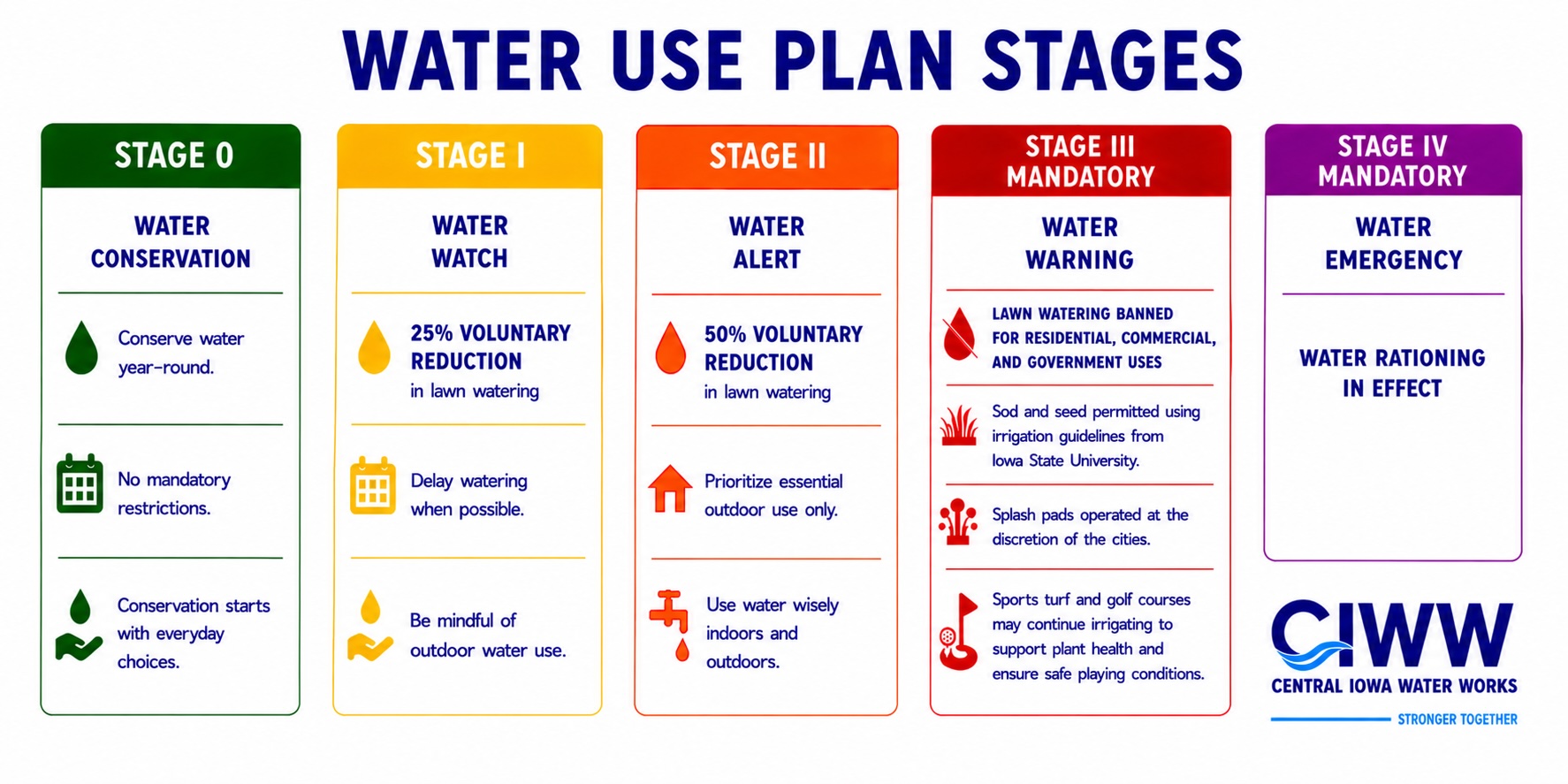
After last year’s watering ban, which lasted from June 12 to Aug. 7, CIWW created a five-stage water-use plan to better deal with strains on its system. The stages range from Stage 0, which involves normal water conservation practices, to Stage IV, an emergency situation that necessitates water rationing. On May 27, CIWW issued a Stage II water alert, asking people to reduce lawn watering by 50 percent and take other steps to conserve water. On Monday, Stage II became Stage III.

Stage III restrictions prohibit lawn watering at residences, businesses and government facilities “except for newly installed sod or seed placed during the current growing season,” which can watered the minimum amount necessary for the sod or seed to become established. Athletic fields and golf courses can also be watered “the minimum necessary for safety and plant preservation.”
Lawn watering is the biggest discretionary use of water during the summer months, accounting for up to 40 percent of water use, according to CIWW.
In addition to the watering ban, Stage III requires that customers “discontinue all unnecessary outdoor use.”
“We are using every available tool in our system to maintain safe drinking water,” CIWW Executive Director Tami Madsen said in a statement on Monday. “Now we now need every customers’ help in reducing demand to maintain safe drinking water standards.”