


More than 50 years before number 22 of the Iowa Hawkeyes was amazing basketball fans and creating new ones, number 55 on the girls basketball team of Union-Whitten High School in Harden County was doing the same. The six-on-six era of girls basketball in Iowa had a lot of dynamic players and high scorers, but even among them, Denise Long stood out. A forward who scored more than 100 points in four games in her high school career, Long would go on to make history as the first woman drafted by the NBA.
Not the WNBA, the NBA. Even Long was surprised by that.
But if a six-on-six player was going to be thrust into the national spotlight, it’s no surprise it would be an Iowan. Because Iowa high schools embraced this style of girls basketball more enthusiastically than almost anyone else. It was mainly played in small, rural schools like Union-Whitten High, where Long was one of 34 seniors who graduated in 1969. In small towns with a team, the girls basketball games were an important part of the community’s social life, from the first six-on-six high school games in the state in 1920 to the final ones in 1993.
It was inevitable that girls would want to play basketball after the game invented by James Naismith in a Massachusetts gym in 1891 gained popularity around the country. It was also inevitable that in early 20th century America there would be worries that girls playing a “boy’s game” would lead to un-ladylike behavior. So rules were devised and uniforms designed for a female version of basketball.
The original six-on-six uniforms were long socks, voluminous bloomers and long sleeve blouses. They concealed all skin south of the neck, except for the hands. The rules of the game were almost as restrictive. The uniform evolved with the times, eventually looking like the gear used today. The rules did not evolve.
It was a half-court game. Three forwards from one team trying to score, three guards from the other team playing defense. The reverse lineup on the other side of the centerline. No crossing the centerline, you stayed on one side.
You couldn’t dribble the ball more than twice in one possession. When not dribbling, you couldn’t hold the ball for more than three seconds. Any physical contact was a foul. Committing a breach of decorum by failing to raise your hand when called for a foul got you a technical foul.
Playing within these strict limitations, the girls and their coaches developed a fast game with lots of passing and shooting. And when it came to shooting, Denise Long was a sensation.
In 1968, the 5’11” forward set a record by scoring 111 points in a regular season game. She also set records for most points in a state tournament game (93 points), most points in a state tournament (282 points), most points in a season (1,986 points) and most career points (6,250 points). Even though Long was a long-distance shooter, all field goals counted for two points, because the three-point line didn’t exist yet.
In February 1969, Sports Illustrated featured Long in a story. The writer reached deep into his bag of incoherent Iowa clichés to describe her: “Like a Grant Wood portrait until she moves, then she’s all swiftness and grace.”
Two months later, Long got a phone call informing her she had been selected in the NBA draft. Franklin Mieuli, the owner of the San Francisco Warriors (now the Golden State Warriors) had used his last pick in the 13th round of that year’s draft to choose Long. Mieuli, who was often politely described as “eccentric” (because he was rich), had never spoken to Long and didn’t give her any advance warning. Long would later tell reporters that when she got the call saying she’d been drafted, she was confused and for a moment thought the caller was telling her she’d been drafted into the military.
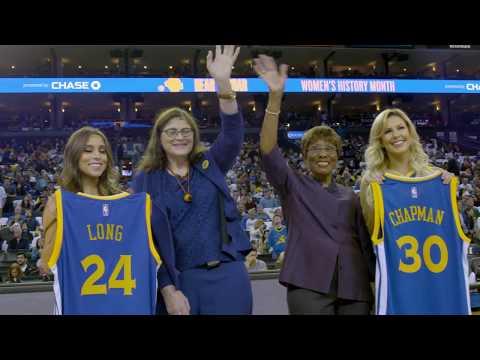
No woman had ever been drafted before, and NBA Commissioner Walter Kennedy wasn’t about to let such a change happen. He immediately voided the Warrior’s pick on the grounds women didn’t play professional basketball.
Long did fly out to San Francisco to meet with Mieuli and the Warriors, unaware it was basically a publicity stunt. Mieuli wanted to start his own women’s basketball league to play exhibition matches before Warriors games. Eccentric but cheap, Mieuli expected the women in his league to play for free. The league, which he tried to build around Long — paying her $5,000 — failed.
The WNBA wouldn’t be founded until 1996. There were no professional playing opportunities for Long to pursue. College opportunities weren’t much better. Before Title IX became law in 1972 the money available for women’s college athletics was meager, and few colleges had a women’s basketball team. The University of Iowa didn’t field a women’s team until 1974.
Long did get some college offers, but scholarship amounts were so low, she wasn’t able to accept them. In 1975, she earned a degree in Bible theology at Faith Baptist Bible College in Ankeny. In the ’90s, Long attended Drake University, graduating with a pharmacy degree, before going on to a long and successful career as a pharmacist in Kansas.
The push for greater equality between men’s and women’s sports jumpstarted by Title IX led to the demise of six-on-six. High school girls were increasingly interested in playing full-court five-on-five, with all the normal rules boys played under instead of the six-on-six restrictions. Starting in 1984, Iowa schools were allowed to choose between five-on-five or six-on-six for their girls basketball teams. Nine years later, the last school playing six-on-six switched to five-on-five.
Although it’s been 31 years since the last high school six-on-six game was played, there’s still a strong connection between that older style and the current UI women’s basketball team that is transforming college basketball.
Hawkeye Head Coach Lisa Bluder played six-on-six growing up in Linn County. Associate Head Coach Jan Jensen not only played six-on-six at Elk Horn-Kimballton High School in rural Shelby County, her grandmother Lottie was a star on the Audubon High School team that won the Iowa state championship in 1921. Lottie’s real name was Dorcas Andersen, but she was given her nickname because she scored “a lot of” points.
Caitlin Clark was born nine years after the last six-on-six high school game in Iowa, but the record-smashing star has made it clear she respects the players of that very different game.
“When I hear from a lot of people that played basketball, whether it was six-on-six however many years ago, I think they’re blown away at where women’s basketball is now and the platform we get to play on,” Clark told reporters earlier this season. “That doesn’t come if it’s not for the people who came before us.”

This article was originally published in Little Village’s April 2024 issue.
